

Be seen. Be heard. Be found.
In Cahoots Co helps wedding planner launch new website
Congratulations to The Finery Wedding Specialists on taking delivery of their new website.
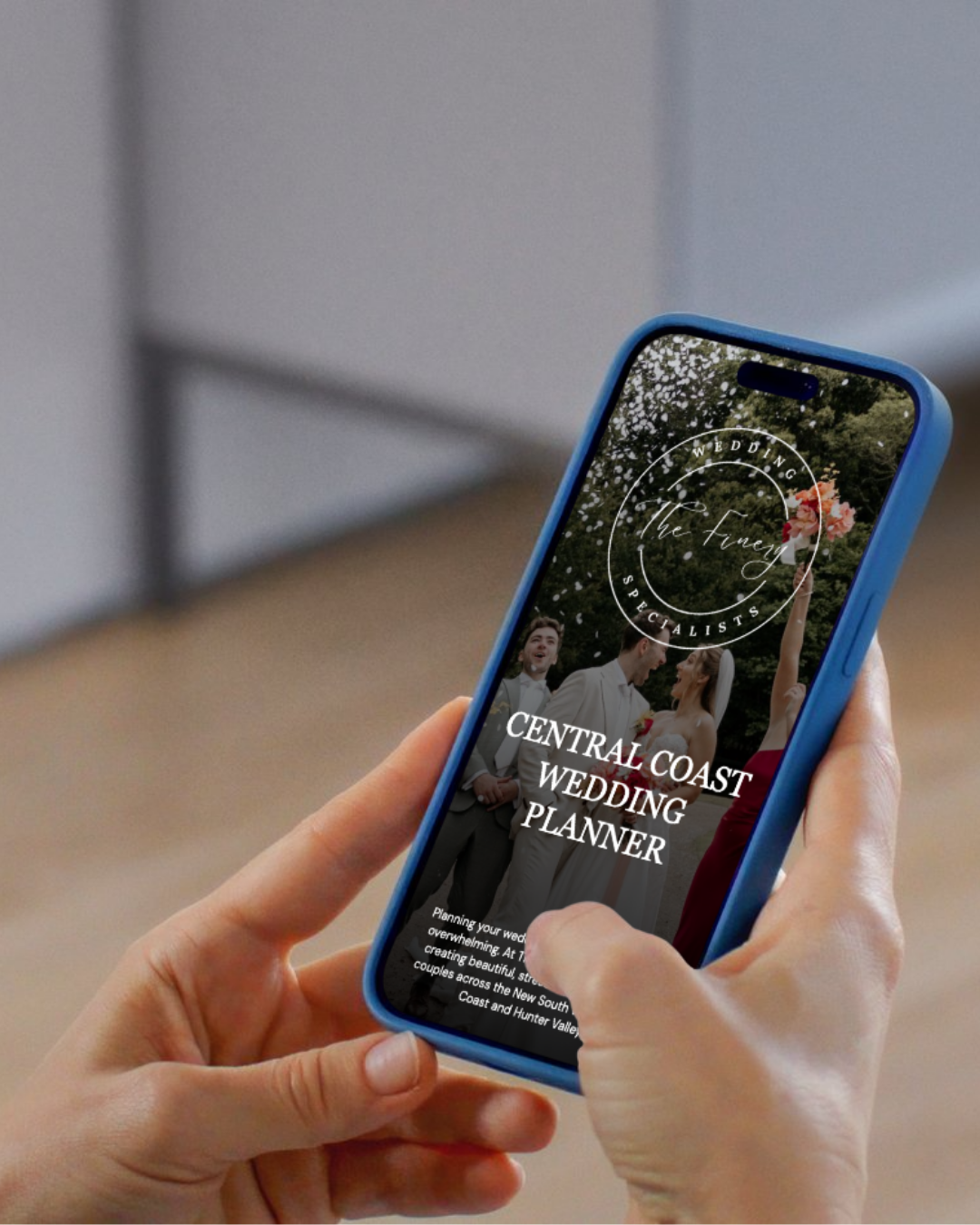
How a boutique NSW wedding planning agency rebuilt its entire digital presence — from platform selection and competitive analysis to SEO, Answer Engine Optimisation, and business development — to compete in the AI era.
A big congratulations to the team at The Finery Wedding Specialists, a NSW central coast wedding planning business.
After undertaking a deep local competitor analysis, we identified gaps within the legacy website and Google Business Profile to provide a data driven plan to improve online visibility across the Central Coast of New South Wales.
Understanding the Business: The Finery and Its Market
Before any website strategy could be developed, a thorough understanding of the business, its clients, and its competitive environment was essential. The Finery is led by head planner Kimberly, whose background in marketing and large-scale event management — including roles at venues such as the Sydney Cricket Ground — gives her a distinctive edge in the wedding industry. Her experience in project management, logistics, and content creation translates directly into the meticulous, client-first service The Finery provides.
The agency specialises in full-service wedding planning, on-the-day coordination, runsheet creation, vendor scouting, and venue sourcing. It serves couples across New South Wales who are time-poor, overwhelmed by the logistics of planning, or simply want to enjoy the journey without the stress. The Finery's positioning is clear: premium, boutique, and deeply personal.
This positioning is well-suited to the current market. Australia's wedding industry is a $4 billion annual market, supporting more than 15,000 active suppliers and servicing over 120,000 weddings per year.
Despite its scale, the market is dominated by small-to-medium enterprises — sole traders and family-run businesses — which means that a well-executed digital strategy can create a significant competitive advantage.
The Starting Point: A Critical Assessment of the Status Quo
The Finery's previous digital presence was built on Squarespace, a platform that serves as an excellent launchpad for new businesses. However, as the agency matured and its ambitions grew, the limitations of that platform became increasingly apparent. The expiration of their Squarespace account was not merely an administrative oversight; it was a signal that the existing digital infrastructure had run its course.
Squarespace is designed primarily for individual creators and small businesses that prioritise aesthetic simplicity over technical depth. While the platform has introduced newer AI-powered optimisation features, its underlying architecture offers limited control over the technical SEO elements that are critical for competitive search performance. For a business that needed to own its digital narrative and build a foundation for long-term organic growth, a more capable platform was necessary.
The audit of the previous site revealed several key gaps. There was no structured schema markup to help search engines understand the business's services, location, and reviews. Page speed and Core Web Vitals performance was not optimised to the standard required by Google's ranking algorithms.
The content architecture was not designed to capture the long-tail, question-based search queries that prospective clients use when beginning their wedding planning journey. And critically, there was no strategy in place to position The Finery as an authoritative voice in the emerging landscape of AI-powered search.
Competitive Analysis: Mapping the Digital Landscape
A thorough competitive analysis was conducted to understand the digital strategies of other wedding planners and coordinators operating in the Central Coast and broader NSW market. This research examined the websites, SEO performance, content strategies, and social media presence of key competitors.
The analysis revealed a striking pattern: the majority of wedding planning businesses in the region have not invested meaningfully in their digital presence beyond a basic website and an active Instagram account. Most competitor sites lack structured data, have minimal blog content, and are not optimised for the specific, intent-driven search queries that prospective clients use. This represents a significant opportunity.
The Platform Decision: Choosing Duda Over the Alternatives
The selection of a new CMS was one of the most consequential decisions in the entire project. The evaluation considered several platforms, including WordPress, Squarespace, Wix, Webflow, and Duda. Each was assessed against a set of criteria directly tied to the strategic goals of the project: performance, SEO capability, ease of management, scalability, and total cost of ownership.
Why Duda Emerged as the Clear Choice
Duda is an agency-first website platform that has been purpose-built for professional web designers and digital marketing agencies. Unlike consumer-oriented builders, it provides the depth of control and the breadth of features required to execute a sophisticated digital strategy.
Performance and Core Web Vitals. Google's Core Web Vitals — a set of metrics measuring loading speed (LCP), interactivity (INP), and visual stability (CLS) — are a confirmed ranking factor. Duda has become the first CMS to achieve an industry-leading 80% pass rate for Core Web Vitals across sites built on its platform.
This means that a website built on Duda starts with a significant performance advantage over competitors built on slower platforms. All Duda sites are automatically optimised for Google PageSpeed upon publishing and republishing, and are served through a global Content Delivery Network (CDN) that reduces load times for visitors across Australia.
Technical SEO Toolset. Duda's built-in SEO features are comprehensive and accessible without requiring developer intervention. The platform includes AI-powered metadata generation (titles and descriptions), AI-generated image alt-text, an SEO audit tool that provides a bird's-eye view of on-page performance, native schema markup support for business info, FAQs, videos, and blog posts, the IndexNow protocol for immediate content submission to search engines, automatic sitemap generation, and full control over robots.txt. For The Finery, the schema markup capabilities are particularly important, as structured data is a foundational element of both traditional SEO and AEO.
AEO-Ready Architecture. Duda's support for structured data and FAQ schema is directly relevant to AEO. When content is marked up with schema, AI systems can more easily parse and cite it in response to user queries. The platform's SEO/AEO settings panel provides a dedicated space for configuring these elements, reflecting Duda's awareness of the shifting search landscape.
Agency and Content Management. Duda's Editor 2.0 provides advanced design capabilities, including flexible container layouts, a native mega menu, and built-in photo editing tools including background removal. The platform's Content Library and Content Collection Form streamline the process of gathering and organising client assets. Multiple blog post layouts allow for a varied and engaging content strategy. These features collectively reduce the friction of building and maintaining a high-quality website over time.
The SEO Strategy: Building a Foundation for Organic Growth
With the platform selected, the SEO strategy was developed in layers, beginning with the technical foundation and building upward through on-page optimisation and content strategy.
Technical SEO
The technical SEO work focused on ensuring that every page of the new website is crawlable, indexable, and understandable to search engines. This involved implementing structured data markup across all key page types, including LocalBusiness schema for the homepage, Service schema for each package, FAQPage schema for the FAQ section, and BreadcrumbList schema for site navigation. These markup types help search engines understand the context and relationships between pages, and they are the same signals that AI answer engines use to evaluate and cite content.
The IndexNow integration is a particularly valuable feature. Rather than waiting for search engine crawlers to discover new or updated content, IndexNow allows Duda to proactively notify search engines the moment content is published or changed. For a business that will be regularly updating its blog and service pages, this ensures that new content enters the search index as quickly as possible.
Local SEO
Local search is the primary channel through which prospective clients discover wedding planners. When someone searches for "wedding planner Central Coast NSW" or "on-the-day coordinator Gosford," they are expressing a clear, high-intent need. Capturing this traffic requires a coordinated local SEO strategy.
The local SEO work for The Finery encompasses several interconnected activities. Optimising the Google Business Profile with accurate business information, service descriptions, photos, and a consistent review acquisition strategy is foundational. Building consistent Name, Address, and Phone (NAP) citations across key directories — including Easy Weddings, ABIA, Central Coast Weddings, and Oneflare — reinforces the business's local authority. The website's content architecture is designed to target location-specific keyword variations, ensuring that The Finery appears for searches across the full range of NSW locations it serves.
On-Page SEO and Content Architecture
The website's information architecture was designed to serve both users and search engines. Each page has a clear, singular purpose and is optimised for a specific set of related keywords. The homepage targets broad, high-intent terms, while individual service pages target more specific, long-tail queries. A dedicated FAQ section, marked up with FAQPage schema, addresses the most common questions prospective clients ask — both in search engines and, increasingly, in AI chat interfaces.
Answer Engine Optimisation: Preparing for the AI-Driven Future of Search
The most forward-looking element of this strategy is the focus on Answer Engine Optimisation (AEO). While the term is relatively new, the underlying principle is straightforward: as more consumers use AI-powered tools to find answers and recommendations, businesses must optimise their content to be selected and cited by those tools.
The Shifting Search Landscape
The search landscape is undergoing a fundamental transformation. Google's AI Overviews now appear at the top of many search results pages, providing synthesised answers before a user ever clicks a link. ChatGPT, with 900 million monthly users, and Gemini, with 650 million, have become significant channels for information discovery.
Perplexity and other AI-native search engines are growing rapidly. For a business like The Finery, this means that the question is no longer just "how do we rank on page one of Google?" but "how do we become the answer that AI systems recommend?"
Research published in 2025 provides a clear picture of how AI engines source their answers. According to a study analysing over one million citations across ChatGPT, Gemini, Claude, and other AI platforms, 82% of links cited by AI come from earned media sources, including journalistic coverage and third-party blogs.
Press release citations increased fivefold between July and December 2025, and approximately 50% of a brand's AI citations come from just 20 media outlets.
This data has profound implications for how The Finery should allocate its marketing investment.
The Three Pillars of AEO for The Finery
AEO is not a replacement for SEO; it is a strategic extension of it. The strategy for The Finery integrates three mutually reinforcing pillars.
Pillar One: Technical Foundation and Structured Data. The work done in technical SEO — particularly the implementation of schema markup and structured data — is the foundation of AEO. AI systems rely on clearly defined entities and structured information to understand what a business is, what it does, and who it serves. By implementing comprehensive schema across the site, The Finery becomes a clearly recognisable entity in the knowledge graphs that underpin AI search.
Pillar Two: Answer-Complete Content. The content strategy is designed to produce material that directly and comprehensively answers the questions that prospective clients ask. This goes beyond simple keyword targeting. Each piece of content is structured to provide a complete, authoritative answer to a specific question — the kind of answer that an AI system would be confident citing. This includes detailed guides on topics like "how to choose a wedding planner in NSW," comparison content explaining the difference between full planning and on-the-day coordination, and FAQ content addressing the most common concerns of couples in the planning process. Content is formatted with clear headings, concise paragraphs, and structured lists where appropriate, making it easy for both humans and AI models to parse and extract information.
Pillar Three: Digital PR and Authority Building. Given that 82% of AI citations come from earned media, building a presence in reputable publications and industry directories is a critical component of the AEO strategy. This involves actively pursuing features in wedding industry publications, contributing expert commentary to relevant media outlets, and building relationships with complementary businesses — photographers, florists, venues, celebrants — who can provide backlinks and co-created content. Each piece of earned media not only drives direct referral traffic but also strengthens the trust signals that AI engines use to evaluate the credibility of a source.
SEARCH ARTICLE
SOCIAL MEDIA CHANNELS


Marketing Strategy
Let's Chat
Automation
Leverage AI. Get your apps talking to
each other.

Website Design
Be Found Online
RECENT POST: