
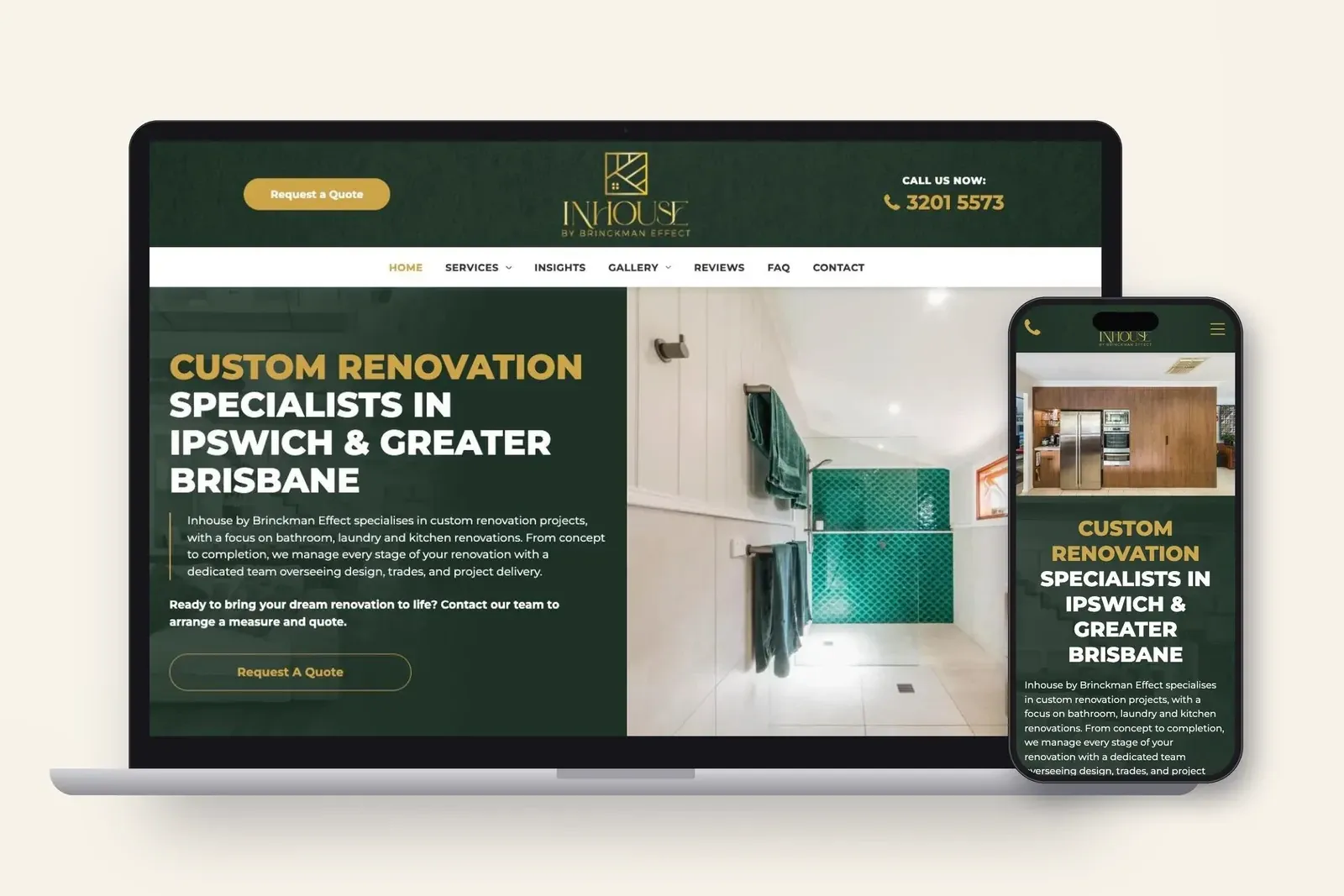
Earlier this year we wrote about moving Inhouse by Brinckman Effect off GoDaddy Airo and onto Duda. With the new site at inhousebybrinckmaneffect.com.au now settled in, here's a closer look at how it's built, and why the structure matters as much as the design.
One page per renovation, one job per page
Inhouse does custom bathroom, ensuite, laundry and kitchen renovations across Ipswich and Greater Brisbane. Each of those is its own search. Someone looking for an ensuite renovation isn't helped by a page that's mostly about kitchens. We took the same approach on the JTM Renovations build.
So each renovation type has its own page, with its own heading, its own search title and description, its own project photos and its own call to action. A Services page ties them together, a Gallery shows the finished work and an Insights section gives room to answer homeowners' questions in more depth.
The copy for every page was planned with the heading structure marked up before any design work started. There's one H1 per page, H2s for each main point and H3s underneath. That's the bones search engines use to understand a page, and it's much harder to fix after a site is built than before.
Website and Google Business Profile, telling the same story
For a local trade business, the Google Business Profile (the listing that shows on Google Maps and in local results) often gets seen before the website does. So we lined the two up.
The profile is verified and set up as a service-area business covering Ipswich and Brisbane, which reflects how Inhouse actually works. Its categories match the website (Bathroom Renovator, with Kitchen Renovator as an additional category). We added ensuite and laundry renovation services that the website genuinely supports, and nothing it doesn't. Regular Google Updates posts each link through to the matching service page, using real project photos rather than stock.
We deliberately left out suburb lists the business doesn't really service, keyword-stuffed descriptions and invented claims. Those shortcuts can get a profile into trouble, and they don't build trust with the people reading it.
Leads you can measure
The site's quote consultation booking is the main conversion. The Meta pixel is connected, so when the business runs Meta ads, Meta can be told which visitors actually enquired rather than which ones just clicked. We also trained Jordan at Inhouse to run her own Meta campaigns, because a business this size shouldn't need an agency for every ad change.
Speed: honest status
The desktop homepage scores 98 for Performance in Google PageSpeed Insights. On mobile it's lower, because the homepage leads with large renovation photography that takes longer to load on a phone. Tightening that up is on our list. We'd rather tell you that than only quote the good number.
Scores are Google PageSpeed Insights lab results for the homepage, tested on 19 November 2026. Lab scores move around a little between runs, and real-visitor data takes time to build up after a launch.
Renovation or trade business?
If your website lumps every service onto one page, you're probably invisible for the searches that matter most. See how we build websites for local businesses, or ask us to take a look.