

Be seen. Be heard. Be found.
Your AI agent doesn't know how to do your job yet. Here's how to teach it.
The blog answers the question: "How do you get your specific business knowledge into an AI permanently, so you don't have to re-explain yourself every time?"
A new standard called Agent Skills lets you download ready-made expertise for your AI (or build your own). It's one of the most practical AI developments for small business owners in 2026, and almost no one is talking about it.

When you first open an AI tool, it's like hiring a brilliant but completely blank-slate contractor. Highly capable. Knows nothing about your business, your industry, your standards, or how you do things. Hand it a task cold, and you'll get something generic. It answers the question ... but it doesn't know your question.
The missing piece has always been: how do you get your specific knowledge into the AI, permanently, so you don't have to explain yourself every single time?
Until recently, the only answer was manual briefing such as pasting your context in at the start of every conversation or more recently in 'project' style folders to provide context so you didn't have to repeat yourself.
That's changed. A new standard called Agent Skills, launched by Anthropic in October 2025 and rapidly adopted across the industry — gives AI tools something they've never had before: a
permanent memory for how to do specific jobs, that you can install, share, download, and build on.1
What is an Agent Skill, in plain English?
Think of an Agent Skill like a staff training manual, but one your AI can actually read and follow.
When you bring on a new employee, you don't just hand them a task. You give them an onboarding document: how the business works, what good looks like, the process to follow, common mistakes to avoid. An Agent Skill is that document - written for an AI, in a format it can load automatically whenever it's relevant.
Without skills
Every time you open AI, you start from zero. Re-explain your business. Re-describe the task. Re-specify your tone. The AI has no memory of what you told it yesterday.
With skills
The AI loads the relevant expertise automatically. It already knows your quoting process, your communication style, your compliance requirements. You just describe the task.
Technically, a skill is a small structured file (a plain text document with a specific format) that lives on your device or in your AI platform. When you ask the AI to do something that matches a skill's purpose, it reads those instructions first. You don't have to invoke it manually. It just knows.
Why this matters now
The Agent Skills standard was launched in October 2025, adopted as an open standard in December 2025, and has since been incorporated into Claude, OpenAI's Codex, GitHub Copilot, and more than 20 other platforms. Google launched its own version inside Chrome in April 2026. This is infrastructure that's being built right now, and early adopters are gaining a genuine edge.
Two ways to get skills: download them or build your own
This is the part that makes Agent Skills genuinely accessible for non-technical business owners. You don't have to build everything from scratch.
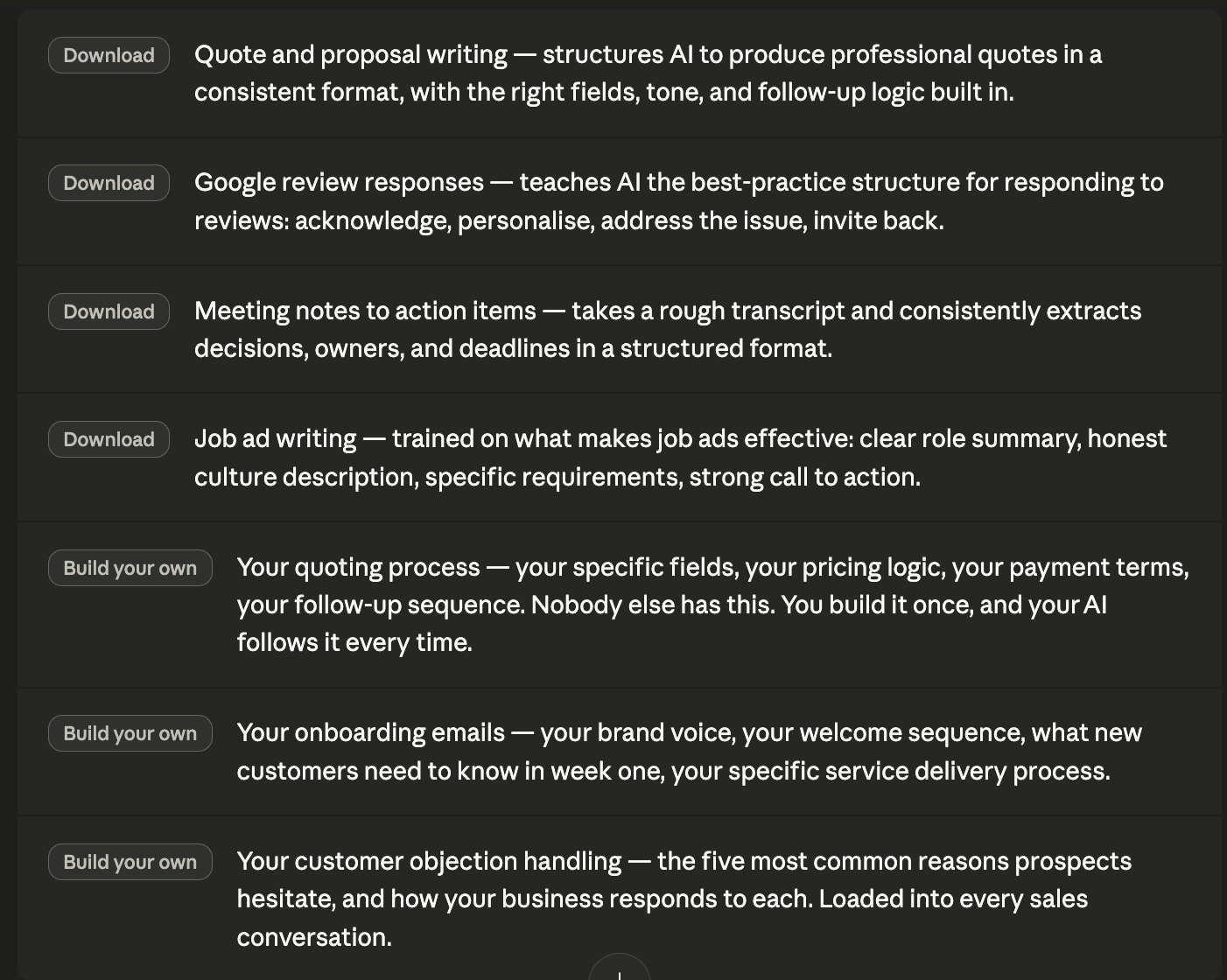
There are already thousands of pre-built skills available in public libraries — created by other businesses, developers, and industry experts, covering a wide range of common tasks. Think of it like an app store, but instead of apps, you're downloading expertise. As of early 2026, one library alone lists over 2,600 ready-to-use skills.
Here are the kinds of skills that exist and are directly relevant to Australian SMEs:
What building your own AI skill actually involves
Here's the part that surprises most business owners: you don't need to write code. You don't need technical expertise. A skill is just a structured text document — closer to writing a well-organised staff handbook than building software.
- Anthropic has stated that workers can create new skills simply by describing what they want to Claude, which then builds the skill file for them. In practice, creating your first custom skill for a non-technical business owner looks something like this:
2. Identify one repeated task that currently requires you to give a long briefing every time — or where the AI output is inconsistent because it doesn't know your standards. Good candidates: quote follow-ups, review responses, social captions, staff updates.
3. Describe it to your AI tool as if briefing a new employee. What does a great output look like? What should it always include? What should it never say? What's the process, step by step? What does success look like?
4. Ask the AI to package that into a skill file. In Claude, for example, you can say: "Turn these instructions into an Agent Skill I can save and reuse." It will produce a formatted SKILL.md document — your permanent training manual for that task.
5. Test and refine it. Run a few real tasks through the skill. Where does the output fall short? Add those instructions. Where does it over-engineer something simple? Trim it. A good skill gets better the more you use it — and unlike a human employee, it never forgets what it learned.
6. Share it with your team. Once a skill works well, anyone in your business can use it and get the same quality output. This is where the compounding begins — you've encoded your expertise into a reusable asset, not just a one-off result.
The business case: why this is worth your attention now
Gartner projects that 40% of small and mid-sized businesses will deploy at least one AI agent by the end of 2026 — up from roughly 8% at the start of 2025. The businesses getting ahead aren't necessarily using better AI. They're using the same tools more systematically — and skills are the mechanism that makes systematic use possible.
The analogy that holds: a tradie who buys an excellent drill but uses it freehand on every job will get inconsistent results. The same tradie who builds a jig — a reusable guide that ensures the drill hits the right spot every time — gets reliable, repeatable quality at speed. Skills are the jig.
There's also a competitive timing argument. The Agent Skills standard is less than six months old. The library of available skills is growing rapidly, but it's still early. The business owners who invest time in building their own skill libraries now — encoding their processes, their voice, their customer knowledge — will have a compounding asset that becomes harder and harder for competitors to replicate. Skills built on your specific business knowledge are, by definition, not available for anyone else to download.
One practical thing to do this week
Open your AI tool of choice — Claude, ChatGPT, Gemini, whichever you use. Think of the task you repeat most often that currently requires you to give the AI a long explanation. Write down, in plain English, everything a new employee would need to know to do that task to your standard.
Then paste it into the AI and say: "I want to turn this into a reusable skill file I can use every time I need this task done. Please structure it as an Agent Skill."
You'll have your first skill in about ten minutes. Run a few real tasks through it. Refine it once. Save it.
That's the beginning of a skill library — and the beginning of an AI that actually knows how to do your job.
SEARCH ARTICLE
SOCIAL MEDIA CHANNELS

Marketing Strategy
Let's Chat

Automation
Leverage AI. Get your apps talking to
each other.

Website Design
Be Found Online
RECENT POST: